Diagnosis
While screening techniques discussed above are useful in determining the possibility of cancer, a further testing is necessary to confirm whether a lump detected on screening is cancer, as opposed to a benign alternative such as a simple cyst.
In a clinical setting, breast cancer is commonly diagnosed using a "triple test" of clinical breast examination (breast examination by a trained medical practitioner), mammography, and fine needle aspiration cytology. Both mammography and clinical breast exam, also used for screening, can indicate an approximate likelihood that a lump is cancer, and may also identify any other lesions. Fine Needle Aspiration and Cytology (FNAC), which may be done in a GP's office using local anesthetic if required, involves attempting to extract a small portion of fluid from the lump. Clear fluid makes the lump highly unlikely to be cancerous, but bloody fluid may be sent off for inspection under a microscope for cancerous cells. Together, these three tools can be used to diagnose breast cancer with a good degree of accuracy.
Other options for biopsy include core biopsy, where a section of the breast lump is removed, and an decisional biopsy, where the entire lump is removed.
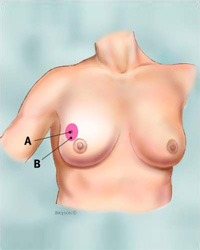
Screening
Breast cancer screening refers to testing otherwise-healthy women for breast cancer in an attempt to achieve an earlier diagnosis. The assumption is that early detection will improve outcomes. A number of screening test have been employed including: clinical and self breast exams, mammography, genetic screening, ultrasound, and magnetic resonance imaging.
A clinical or self breast exam involves feeling the breast for lumps or other abnormalities. Evidence however does not support its use. Mammographic screening for breast cancer is also controversial. It uses x-rays to examine the breast for any uncharacteristic masses or lumps. The Cochrane collaboration in 2009 concluded that it is unclear whether screening does more good than harm. Many national organizations however recommend it. If mammography is decided upon it should only be done every two years in women between the ages of 50 and 74.
In women at high risk, such as those with a strong family history of cancer, additional testing may include genetic screening and / or magnetic resonance imaging. Genetic screening involves testing for mutations in the BRCA genes.
Management
The mainstay of breast cancer treatment is surgery. Adjuvant hormonal therapy (with tamoxifen or an aromatase inhibitor) is given when the tumor expresses estrogen receptors or progesterone receptors. Chemotherapy is given for more advanced stages of disease. Monoclonal antibodies are sometimes used, especially for HER2-positive tumors. Radiotherapy is given after surgery to the region of the tumor bed, to destroy microscopic tumors that may have escaped surgery. Treatments are constantly being evaluated in randomized, controlled trials, to evaluate and compare individual drugs, combinations of drugs, and surgical and radiation techniques. The latest research is reported annually at scientific meetings such as that of the American Society of Clinical Oncology, San Antonio Breast Cancer Symposium, and the St. Gallen Oncology Conference in St. Gallen, Switzerland. These studies are reviewed by professional societies and other organizations, and formulated into guidelines for specific treatment groups and risk category.
In planning treatment, doctors can also use PCR tests like Oncotype DX or microarray tests that predict breast cancer recurrence risk based on gene expression. In February 2007, the first breast cancer predictor test won formal approval from the Food and Drug Administration. This is a new gene test to help predict whether women with early-stage breast cancer will relapse in 5 or 10 years, this could help influence how aggressively the initial tumor is treated.
Radiation therapy is also used to help destroy cancer cells that may linger after surgery. Radiation therapy can be delivered as external beam radiotherapy or as brachytherapy (internal radiotherapy). Radiation can reduce the risk of recurrence by 50-66% (1/2 - 2/3rds reduction of risk) when delivered in the correct dose.
Prognosis
A prognosis is the medical team's "best guess" in how cancer will affect a patient. There are many prognostic factors associated with breast cancer: staging, tumor size and location, grade, whether disease is systemic (has metastasized, or traveled to other parts of the body), recurrence of the disease, and age of patient.
Stage is the most important, as it takes into consideration size, local involvement, lymph node status and whether metastatic disease is present. The higher the stage at diagnosis, the worse the prognosis. The stage is raised by the invasiveness of disease to lymph nodes, chest wall, skin or beyond, and the aggressiveness of the cancer cells. The stage is lowered by the presence of cancer-free zones and close-to-normal cell behaviour (grading). Size is not a factor in staging unless the cancer is invasive. Ductal Carcinoma in situ throughout the entire breast is stage zero.
Grading is based on how biopsied, cultured cells behave. The closer to normal cancer cells are, the slower their growth and the better the prognosis. If cells are not well differentiated, they will appear immature, will divide more rapidly, and will tend to spread. Well differentiated is given a grade of 1, moderate is grade 2, while poor or undifferentiated is given a higher grade of 3 or 4 (depending upon the scale used).
Younger women tend to have a poorer prognosis than post-menopausal women due to several factors. Their breasts are active with their cycles; they may be nursing infants, and may be unaware of changes in their breasts. Therefore, younger women are usually at a more advanced stage when diagnosed. There may also be biologic factors contributing to a higher risk of disease recurrence for younger women with breast cancer.
The presence of estrogen and progesterone receptors in the cancer cell, while not prognostic, is important in guiding treatment. Those who do not test positive for these specific receptors will not respond to hormone therapy.
Likewise, HER2/neu status directs the course of treatment. Patients whose cancer cells are positive for HER2/neu have more aggressive disease and may be treated with trastuzumab, a monoclonal antibody that targets this protein.
Elevated CA15-3, in conjunction with alkaline phosphatase, was shown to increase chances of early recurrence in breast cancer.
Psychological aspects
The emotional impact of cancer diagnosis, symptoms, treatment, and related issues can be severe. Larger hospitals are associated with cancer support groups which provide a supportive environment to help patients cope and gain perspective from cancer survivors. Online cancer support groups are also very beneficial to cancer patients, especially in dealing with uncertainty and body-image problems inherent in cancer treatment.
Not all breast cancer patients experience their illness in the same manner. Factors such as age can have a significant impact on the way a patient copes with a breast cancer diagnosis. Premenopausal women with estrogen-receptor positive breast cancer must confront the issues of early menopause induced by many of the chemotherapy regimens used to treat their breast cancer, especially those that use hormones to counteract ovarian function.
On the other hand, a recent study conducted by researchers at the College of Public Health of the University of Georgia showed that older women may face a more difficult recovery from breast cancer than their younger counterparts. As the incidence of breast cancer in women over 50 rises and survival rates increase, breast cancer is increasingly becoming a geriatric issue that warrants both further research and the expansion of specialized cancer support services tailored for specific age groups.
Epidemiology
Worldwide, breast cancer is the most common cancer in women after skin cancer representing 16% of all female cancers. The rate is more than twice that of colorectal cancer and cervical cancer and about three times that of lung cancer. Mortality worldwide is 25% greater than that of lung cancer in women. In 2004, breast cancer caused 519,000 deaths worldwide (7% of cancer deaths; almost 1% of all deaths). The number of cases worldwide has significantly increased since the 1970s, a phenomenon partly attributed to the modern lifestyles.
The incidence of breast cancer varies greatly around the world, being lower in less-developed countries and greatest in the more-developed countries. In the twelve world regions, the annual age-standardized incidence rates per 100,000 women are as follows: in Eastern Asia, 18; South Central Asia, 22; sub-Saharan Africa, 22; South-Eastern Asia, 26; North Africa and Western Asia, 28; South and Central America, 42; Eastern Europe, 49; Southern Europe, 56; Northern Europe, 73; Oceania, 74; Western Europe, 78; and in North America, 90.
Breast cancer is strongly related to age with only 5% of all breast cancers occur in women under 40 years old.
United States
The lifetime risk for breast cancer in the United States is usually give as 1 in 8 (12.5%) with a 1 in 35 (3%) chance of death. A recent analysis however has called this estimate into question when it found a risk of only 6% in healthy women.
The United States have the highest annual incidence rates of breast cancer in the world; 128.6 per 100,000 in whites and 112.6 per 100,000 among African Americans. It is the second-most common cancer (after skin cancer) and the second-most common cause of cancer death (after lung cancer). In 2007, breast cancer was expected to cause 40,910 deaths in the US (7% of cancer deaths; almost 2% of all deaths). This figure includes 450-500 annual deaths among men out of 2000 cancer cases.
In the US, both incidence and death rates for breast cancer have been declining in the last few years in Native Americans and Alaskan Natives. Nevertheless, a US study conducted in 2005 by the Society for Women's Health Research indicated that breast cancer remains the most feared disease, even though heart disease is a much more common cause of death among women. Many doctors say that women exaggerate their risk of breast cancer.
Racial disparities
Several studies have found that black women in the U.S. are more likely to die from breast cancer even though white women are more likely to be diagnosed with the disease. Even after diagnosis, black women are less likely to get treatment compared to white women. Scholars have advanced several theories for the disparities, including inadequate access to screening, reduced availability of the most advanced surgical and medical techniques, or some biological characteristic of the disease in the African American population. Some studies suggest that the racial disparity in breast cancer outcomes may reflect cultural biases more than biological disease differences. Research is currently ongoing to define the contribution of both biological and cultural factors.
UK
45,000 cases diagnosed and 12,500 deaths per annum. 60% of cases are treated with Tamoxifen, of these the drug becomes ineffective in 35%.
Developing countries
As developing countries grow and adopt Western culture they also accumulate more disease that has arisen from Western culture and its habits (fat/alcohol intake, smoking, exposure to oral contraceptives, the changing patterns of childbearing and breastfeeding, low parity). For instance, as South America has developed so has the amount of breast cancer. “Breast cancer in less developed countries, such as those in South America, is a major public health issue. It is a leading cause of cancer-related deaths in women in countries such as Argentina, Uruguay, and Brazil. The expected numbers of new cases and deaths due to breast cancer in South America for the year 2001 are approximately 70,000 and 30,000, respectively.” However, because of a lack of funding and resources, treatment is not always available to those suffering with breast cancer.
History
Breast cancer may be one of the oldest known forms of cancerous tumors in humans. The oldest description of cancer was discovered in Egypt and dates back to approximately 1600 BC. The Edwin Smith Papyrus describes 8 cases of tumors or ulcers of the breast that were treated by cauterization.The writing says about the disease, "There is no treatment."[70] For centuries, physicians described similar cases in their practises, with the same conclusion. It was not until doctors achieved greater understanding of the circulatory system in the 17th century that they could establish a link between breast cancer and the lymph nodes in the armpit. The French surgeon Jean Louis Petit (1674–1750) and later the Scottish surgeon Benjamin Bell (1749–1806) were the first to remove the lymph nodes, breast tissue, and underlying chest muscle. Their successful work was carried on by William Stewart Halsted who started performing mastectomies in 1882. The Halsted radical mastectomy often involved removing both breasts, associated lymph nodes, and the underlying chest muscles. This often led to long-term pain and disability, but was seen as necessary in order to prevent the cancer from recurring. Radical mastectomies remained the standard until the 1970s, when a new understanding of metastasis led to perceiving cancer as a systemic illness as well as a localized one, and more sparing procedures were developed that proved equally effective.
Prominent women who died of breast cancer include Empress Theodora, wife of Justinian; Anne of Austria, mother of Louis XIV of France; Mary Washington, mother of George, and Rachel Carson, the environmentalist.
The first case-controlled study on breast cancer epidemiology was done by Janet Lane-Claypon, who published a comparative study in 1926 of 500 breast cancer cases and 500 control patients of the same background and lifestyle for the British Ministry of Health.